
Merkle Trees
Merkle trees are a fundamental data structure in Bitcoin that enable efficient verification of transaction inclusion in blocks. They provide cryptographic proof that specific transactions are part of a block without downloading the entire block. The structure is named after Ralph Merkle, who invented it in 1979; Satoshi cited the concept in the Bitcoin whitepaper.
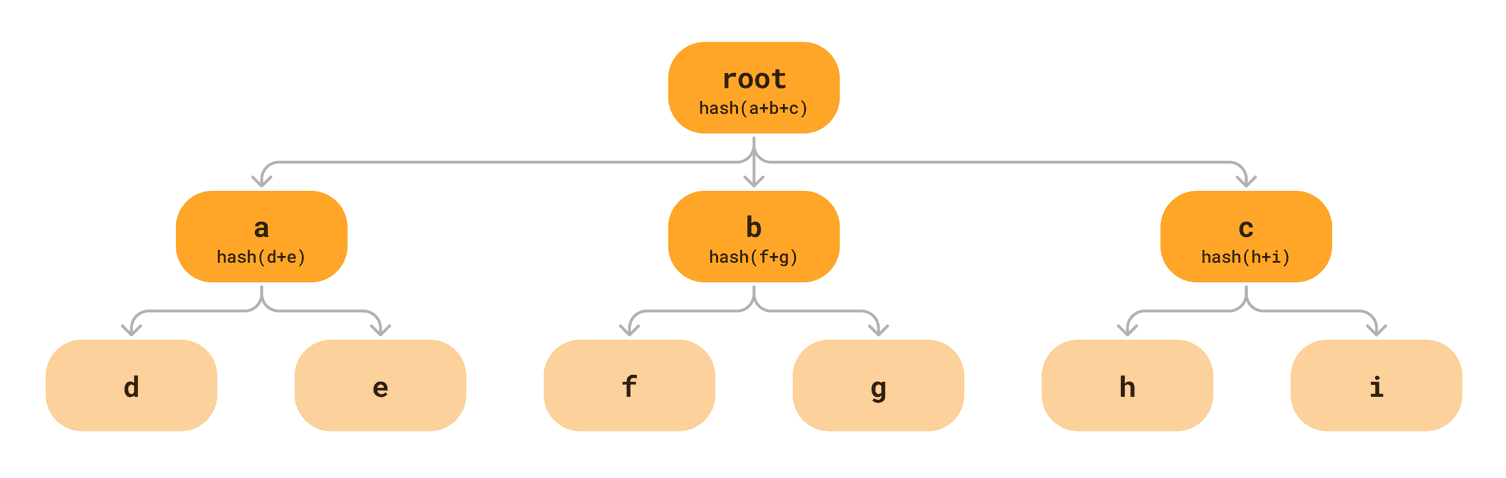
Merkle Tree Structure
A Merkle tree (also called a hash tree) is a binary tree where:
- Leaves: Hash of individual transactions
- Internal nodes: Hash of child nodes
- Root: Single hash representing all transactions
The Merkle root is stored in the block header, providing a compact commitment to all transactions in the block.
Construction
- Hash each transaction: Create leaf nodes
- Pair and hash: Combine pairs, hash result
- Repeat: Continue until single root hash
- Store root: Root hash goes in block header
The same double SHA-256 used in Merkle nodes can be tried in the Hash tool.
Verification
To prove transaction inclusion:
- Request Merkle path: Get hashes needed to reconstruct path
- Reconstruct path: Hash from transaction to root
- Compare roots: Match against block header root
Building a Merkle Tree
Merkle trees enable SPV clients:
SPV Client:
1. Downloads block headers only (~80 bytes each)
2. Requests Merkle proof for specific transaction
3. Verifies proof without full block
4. Confirms transaction inclusion
Merkle Proof
Verification:
- Hash(Tx2) = leaf hash
- Hash(Hash(Tx1) + Hash(Tx2)) = Hash AB
- Hash(Hash AB + Hash CD) = Root
- Root matches block header ✓
Merkle root is stored in block header:
[Block Header 80 bytes]
├── Version (4 bytes)
├── Previous Block Hash (32 bytes)
├── Merkle Root (32 bytes) - Merkle tree root
├── Timestamp (4 bytes)
├── Difficulty Target (4 bytes)
└── Nonce (4 bytes)
Efficiency
- Compact proofs: Small Merkle paths vs. full blocks
- Fast verification: Logarithmic complexity
- Bandwidth savings: SPV clients need minimal data
Security
- Cryptographic integrity: Any change breaks root hash
- Tamper detection: Modified transactions invalidate root
- Trustless verification: No need to trust third parties
- Block Structure - How blocks are organized
- SPV - Simplified payment verification
- Cryptography - Hash functions